
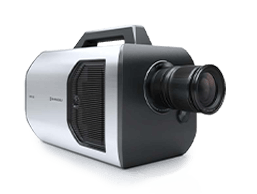
Hyper Vision HPV-x3

Extreme Speed with high Resolution

Recording Speeds20 Mfps at 300,000 pixels
Synchronizationaccurate to 5 nsec


Visualization Technology that Drives Science and Technology

Visualization technology has been responsible for dramatic advances in medical care and the industrial sector. For example, the invention of the microscope allowed humans to observe microscopic objects otherwise too small for the naked eye, and radiography systems and infrared cameras are able to create images from wavelengths of light outside of the visible spectrum. Similarly, high-speed cameras allow humans to capture images of phenomena that are otherwise too quick for human perception. As an established tool in the field of ultra high-speed visualization, the HyperVision series high-speed video camera helps improve our understanding of ultra high-speed phenomena in a variety of fields.

Export Control Regulations
Any export of a Shimadzu High-Speed Camera, HPV-X3/HPV-X2/HPV-X/HPV-2, is subject to export control regulations of the nation, based on Part 2 of the NSG guideline, 5.B.3.

Highlights

High Image Resolution Across an Impressive Range of Recording Speeds

  • 20 Mfps at 300,000 pixels

External Input/Output Functionality for Synchronized Image Capture

  • Synchronization accurate to 5 nsec

Flexible Design and
Superior Ease-of-Use

  • Meets varied application requirements

High Image Resolution Across an Impressive Range of Recording Speeds

Burst Method for Ultra High-Speed Recording

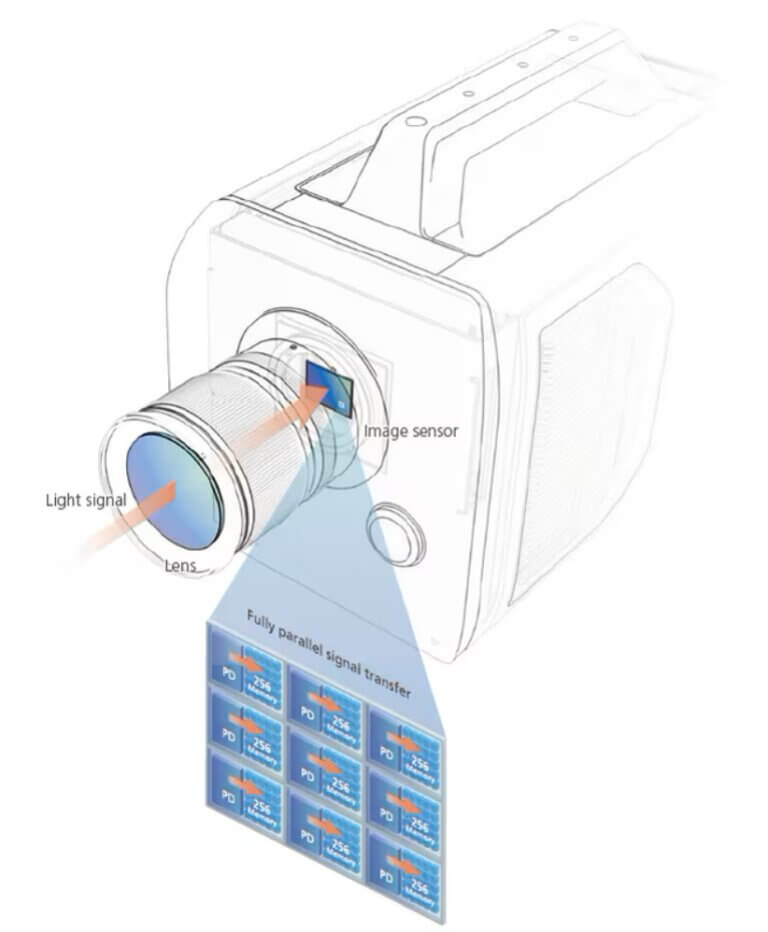
High-speed cameras typically store images in memory located separate from the image sensor. Image data is transferred serially from each sensor pixel to the memory in a sequential arrangement through output connections that number relatively few compared to the number of pixels in the image. This configuration makes ultra high-speed recording at 1 Mfps or above hard to achieve.

The burst method used by Shimadzu places enough memory to record the frame capture capacity of the image sensor directly on the sensor and links every pixel to this memory through individual connections. This configuration allows signals to be transferred from the pixels to memory in a fully parallel arrangement for ultra high-speed recording at 20 Mfps. This design removes the limitations imposed by sequential signal transfer via a restricted number of connections, thereby allowing for ultra high-speed, high-resolution image recording.

Three Times Higher Image Sensor Resolution (300,000 pixels)

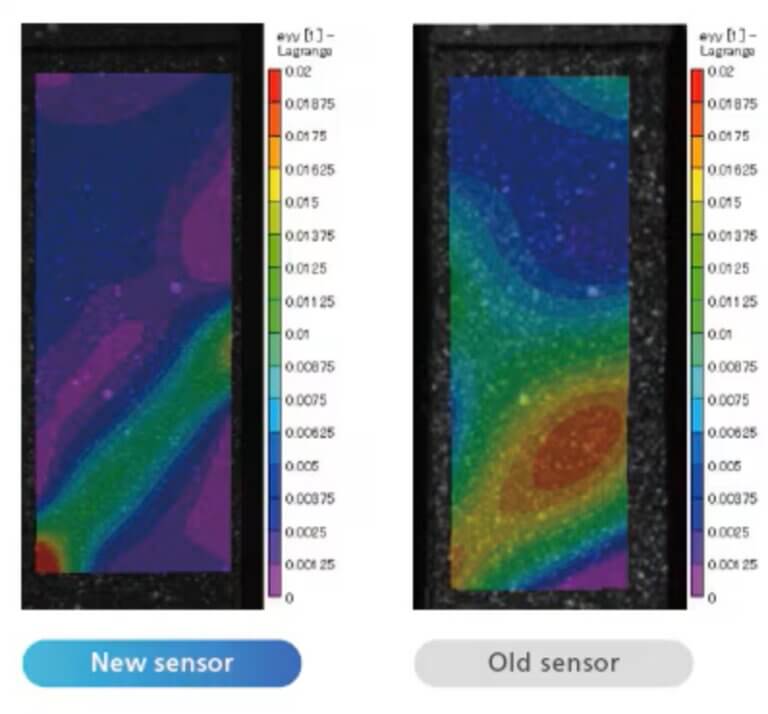
The new image sensor has three times the number of pixels and six times the amount of memory thanks to a reduction in memory size. This technology is used to achieve an improved image resolution of 300,000 pixels with no negative effect on frame rate. The higher image sensor resolution also provides more accurate measurements in applications that use Digital Image Correlation (DIC) technology.

Note: FTCMOS and FTCMOS3 sensors were developed through joint research with Professor Shigetoshi Sugawa of Tohoku University. Patents: 04931160, 04844853, 04844854

Improved Image Sensor Resolution for Improved DIC Analysis Performance

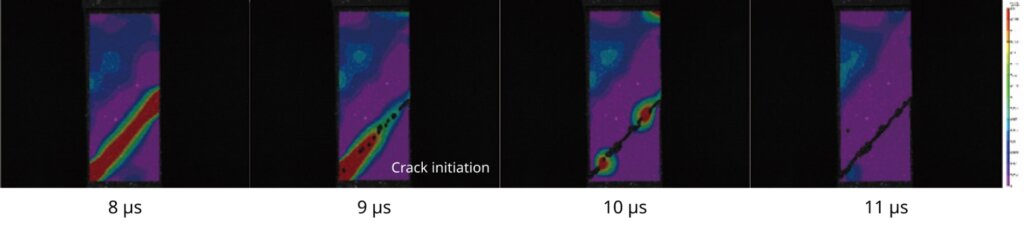
The resolution of the HPV-X3 image sensor is three times that of its predecessor. The resulting improvement in DIC analysis performance was verified by simultaneously capturing images of a single specimen with the new and old sensor and comparing the results. The resulting DIC image clearly shows a build-up of strain in the material just before crack initiation.

External Input/Output Functionality for Synchronized Image Capture

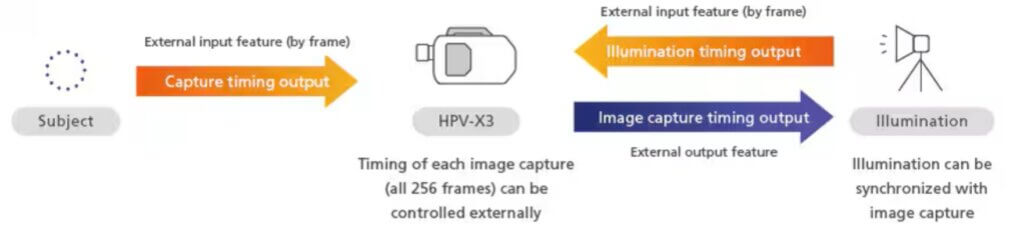
Synchronizing image capture with the subject and an illumination source is an extremely important aspect of high-speed visualization. In addition to having an existing external output feature that synchronizes subject illumination by sending the image capture timing signal to an external illumination device, the HPV-X3 comes with an external input and frame synchronization features that allow 256 individual frames to be synchronized to an external signal. With this technology, the camera can begin image exposure in response to a timing signal with an accuracy of 5 nsec. The timing accuracy of the HPV-X3 has also been improved from S10 nsec to 5 nsec. These improvements provide the user with highly reliable synchronized image capture.

Flexible Design and Superior Ease-of-Use

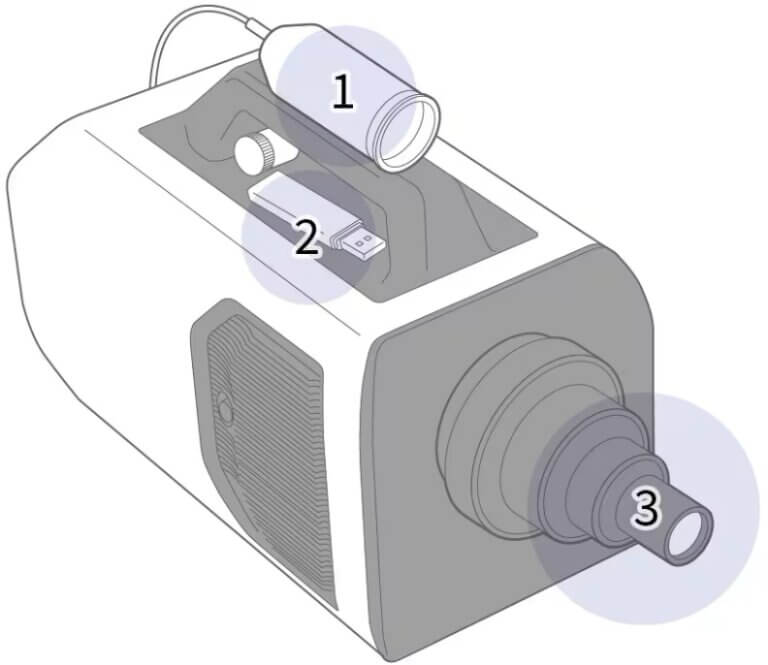
The HPV-X3 is designed to combine flexibility with excellent ease-of-use. The camera comes with a variety of features that ensure it meets the needs of a wide range of users.

1. Illumination

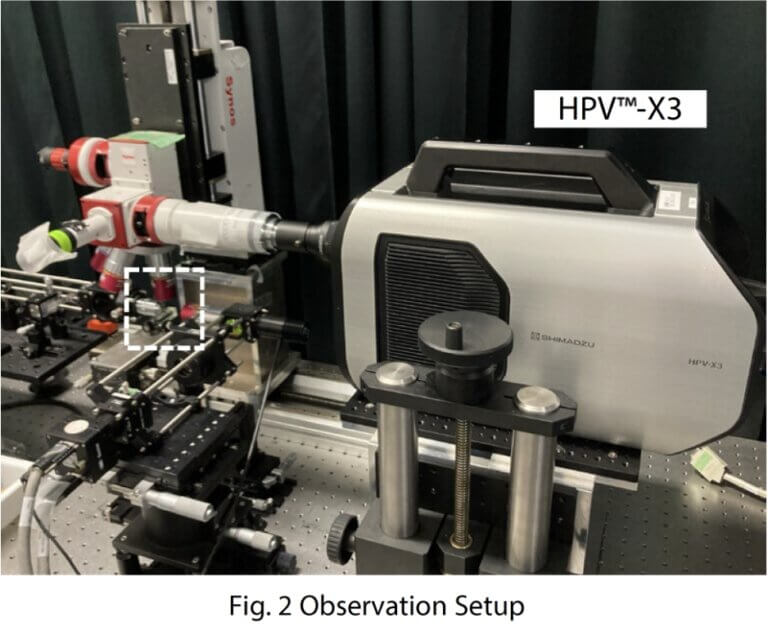
A utility screw mount placed on top of the camera can be used to attach fixtures for illumination or other apparatus.

2. Handle tray

A tray built on the top of the camera can be used as temporary storage for tools and fixtures.

3. Microscope

The camera can be used with a microscope by mounting a commercially available F-C mount lens adapter.

Camera Synchronization and Dual-Camera Control

The control software can control two cameras. This allows the user to capture images with two cameras simultaneously and then play the recorded images on a single PC.

Software Development Kit (SDK) for Improved System Development

For seamless integration of the HPV-X3 with commercial DIC software and user-developed analytical software, a software development kit (SDK)* has been published.

Note: Purchase of a separate SDK license certification kit is required to operate the HPV-X3 with an SDK.

Material

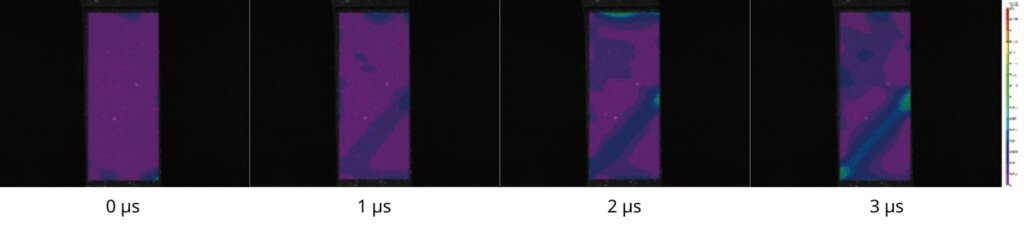
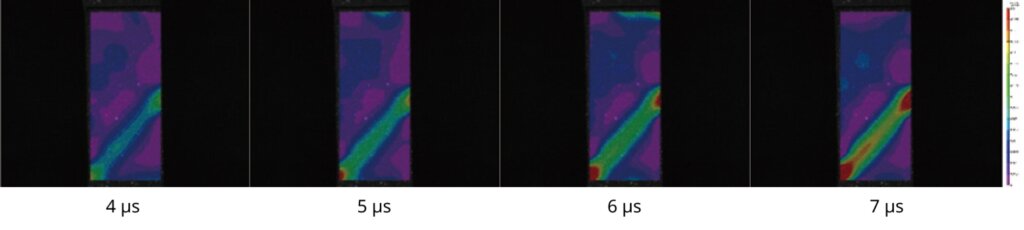
DIC Analysis for High-Speed Tensile Testing of CFRPs

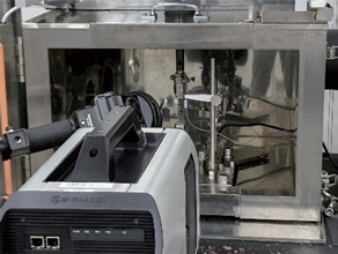
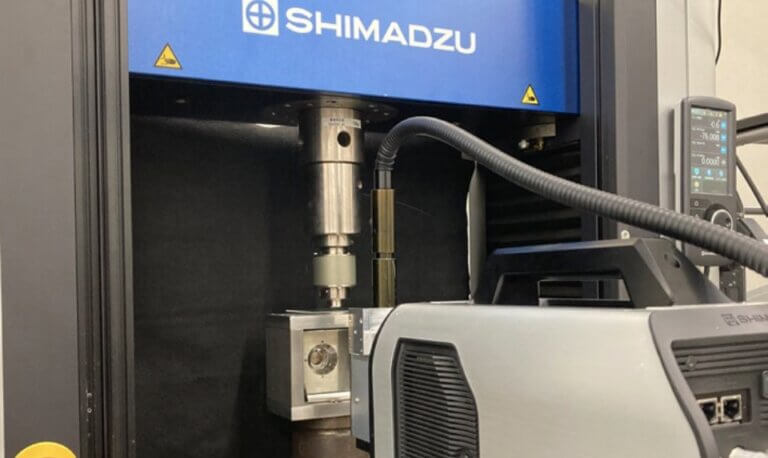
Both static and dynamic material properties, such as impact characteristics, are important for understanding the behavior of materials. Carbon fiber reinforced plastics (CFRPs) exhibit brittle fracture behavior with fracture progression that occurs instantaneously upon damage, and observing this phenomenon requires high-speed video cameras with excellent recording speeds and resolution. The improved resolution of the image sensor in the HPV-X3 improves camera performance for DIC analysis.

Recording speed: 20 Mfps, Test speed: 10 m/s, Specimen width: 12 mm

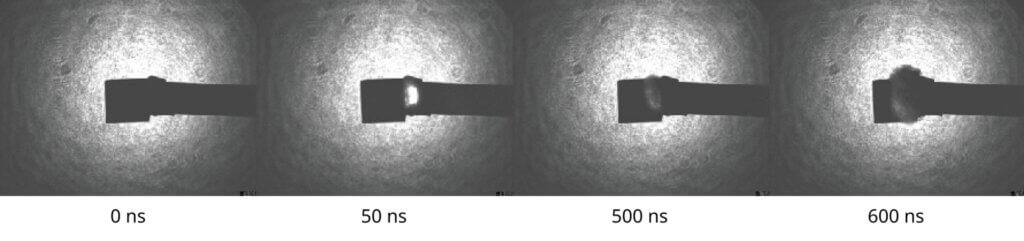
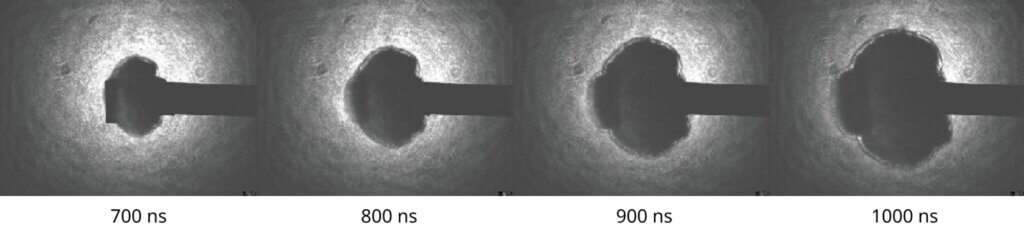
Observing Blast and Shock Waves During Detonation of Micro-Explosives

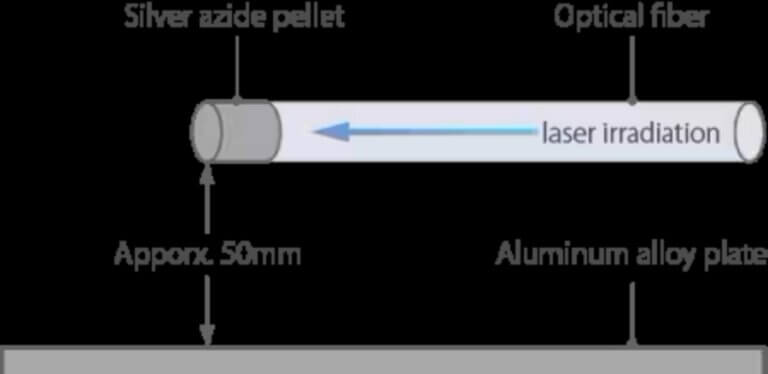
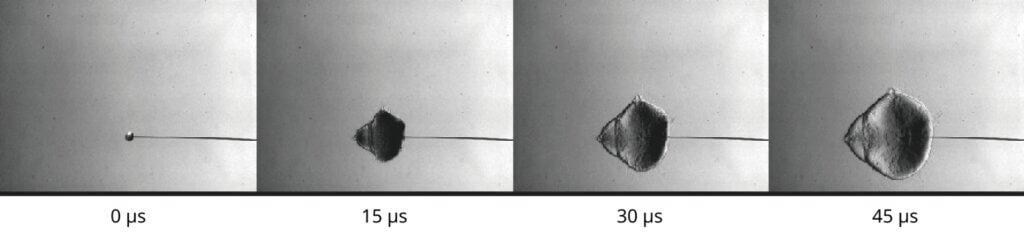
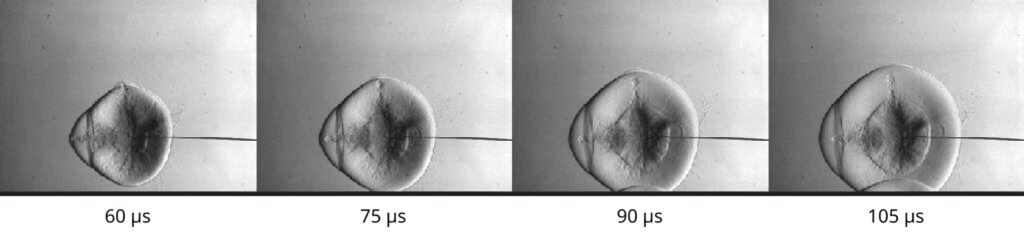
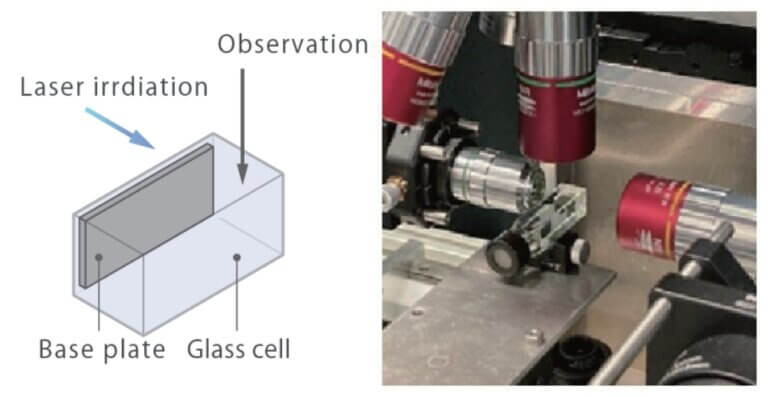
A silver azide pellet was detonated with a laser and the resulting blast and shock wave propagation was visualized in Schlieren images. The shock wave propagated around the blast wave and its reflection was visualized clearly in an aluminum alloy plate.

Recording speed: 1 Mfps, Field of view width: approx. 250 mm

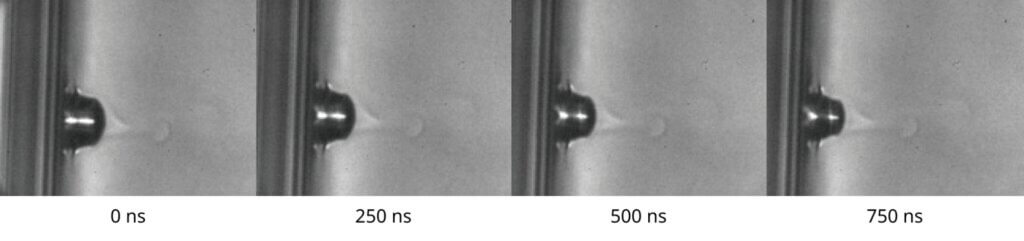
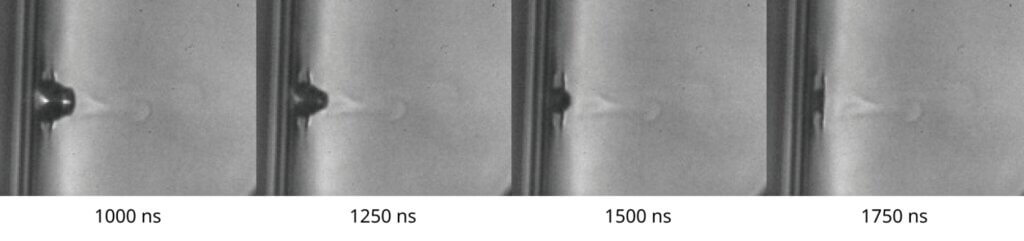
Images of the area around a silver azide pellet during detonation were captured at 20 Mfps. The images captured a blast wave
that appeared approx. 450 ns after laser irradiation of the pellet, which was followed by the progression of a shock wave around the blast wave.

Recording speed: 20 Mfps, Field of view width: approx. 5 mm
Images captured by: Specially Appointed Associate Professor Kiyonobu Otani, Institute of Fluid Science, Tohoku University

Life Science

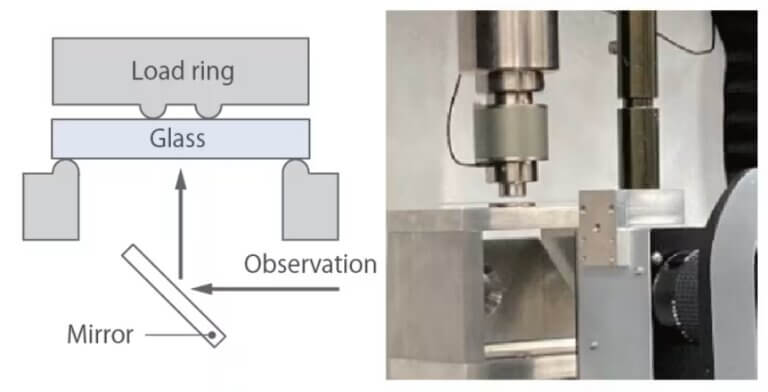
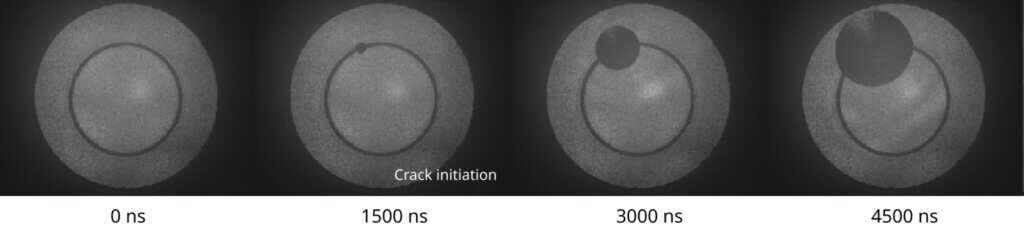
Observing Crack Progression During Ring-on-Ring Testing of Glass

Ring-on-ring testing was performed on reinforced glass and
images were captured of the cracks that occurred during failure.
(Reference standard: ASTM C1499)

Recording speed: 10 Mfps, Field of view width: approx. 45 mm

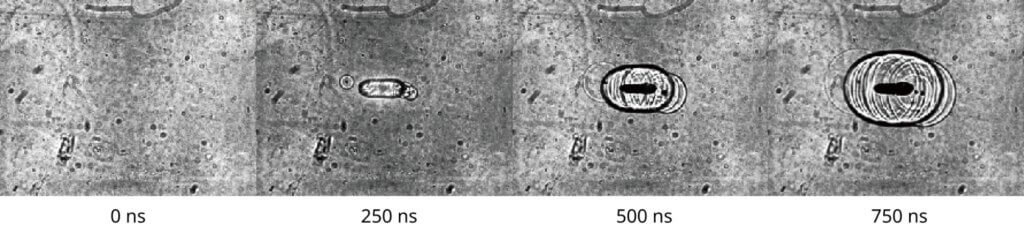
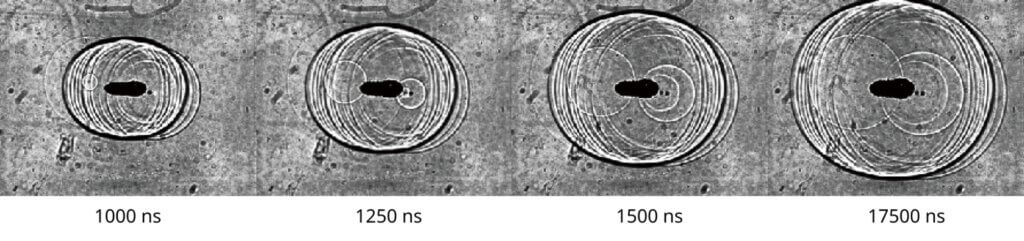
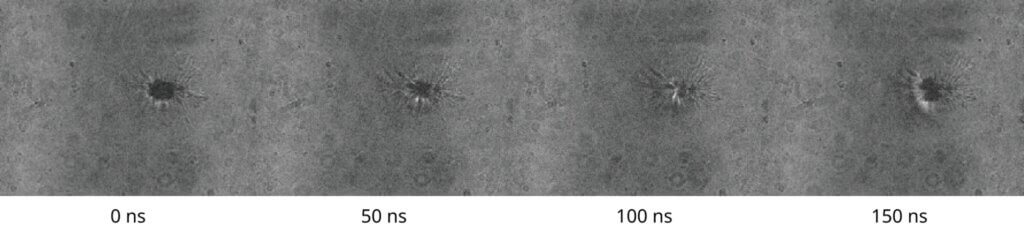
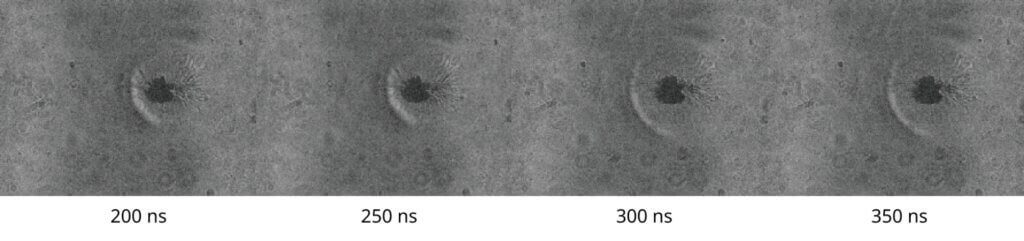
Expansion and Contraction of Bubbles in Polyvinyl Alcohol (PVA) Gel

Images were captured of bubbles being formed while PVA gel was irradiated with a laser. Bubbles were observed to repeatedly expand and contract inside the gel. Images captured by the camera show the progression of shock waves produced when the bubbles were formed and collapsed.

Bubble Formation

Recording speed: 20 Mfps, Field of view width: approx. 75 mm

Bubble Collapse

Recording speed: 20 Mfps, Field of view width: approx. 20 mm
Images captured by: Associate Professor Tokitada Hashimoto, Department of Mechanical Engineering, Faculty of Science and Engineering, Saga University

Observing the High-Frequency Oscillation of Microbubbles

Images were captured of microbubbles that formed in water when the water was irradiated and heated locally with a laser. The microbubbles first expanded then contracted and the images show a jet flow that occurs during contraction as the bubble disappears.

Recording speed: 20 Mfps, Field of view width: approx. 110 um, Images captured by: Associate Professor Kyoko Namura, Department of Micro Engineering, Graduate School of Engineering, Kyoto University

Applications

Lorem

Lorem

Lorem

Lorem

Lorem

Lorem

Lorem

Lorem

Technical data: Hyper Vision HPV-X3


 Hyper Vision HPV-X3 
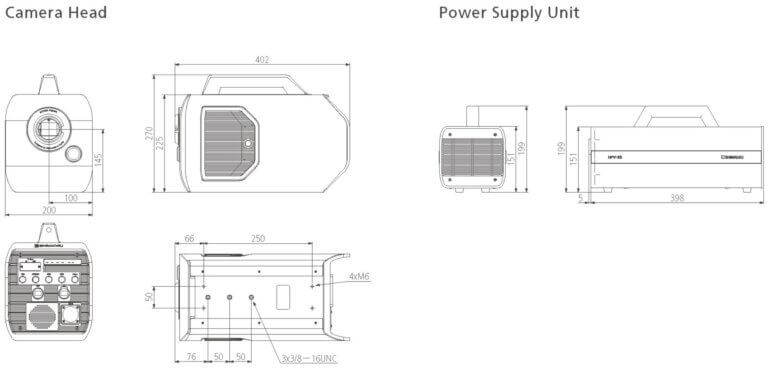
Camera Head  
Lens Mount*1)Nikon F-mount 
Image Sensor*2)FTCMOS3 image sensor (approx. 30 × 23 mm) 
Pixel Size48 μm × 48 μm 
Recording Speed*3)
(frame rate)
  • 20 Mfps
  • Variable recording speed between 60 fps and 10 Mfps in 5 ns steps
 
Recording Capacity256 frames 
Resolution*4)300,000 pixels; 628 horizontal x 480 vertical 
Color/Gradations*5)Monochrome, 10 bits 
Exposure Time*6)20 Mfps, fixed at approx. 25 ns
Variable in a 5 ns interval starting from 50 ns in a range from 60 fps to 10 Mfps
 
External Trigger Input
  • Two channels (TRIG, STANDBY)
  • TTL level (5 V), capable of either positive or negative polarity
  • Or contact input
  • Time resolution 5 ns
 
Recording ModeInternal trigger, external trigger, continuous trigger 
Camera Synchronization Function*7)Capable of synchronized recording with 2 cameras connected 
Frame Synchronization Function*7)

Signal/level

  • One channel (F.SYNC)
  • TTL level (5 V), capable of either positive or negative polarity
  • Or contact input
  • Time resolution 5 ns Recording speed
  • Range between 60 fps and 10 Mfps
 
Operational OutputTwo channels (exposure start timing, trigger detection timing, or other outputs depending on settings) 
Trigger Point SettingCan be set to any frame from the second frame onwards 
Interface*8)1000Base-T 1 port 
External Monitor Output*9)External Monitor Output 
Data Memory Format10-bit dedicated format, BMP, AVI, JPEG, TIFF (8-bit and 16-bit formats supported) 
 

1) * Shimadzu does not guarantee that all F-mount lenses can be attached.
2)* The FTCMOS3 image sensor used in this instrument is manufactured using high accuracy technology, but defective pixels may exist. Note that this is not a defect or failure of the product.
Please note that some image sensor attributes are not published. When purchasing an HPV-X3, please request an image capture demonstration to verify product operation in your operating environment.
3)* The recording speed is a reference value. It is not guaranteed to be an accurate value for the time interval between recording frames.
4)* Stored images will be 628 pixels (horizontal) × 480 pixels (vertical).
5)* 10-bit refers to the data format. It does not indicate a guarantee of data precision.
6)* These exposure times are rough indications and are not guaranteed as exact exposure time ratios for all recording speeds.
7)* The synchronization function value is for reference only. It is not guaranteed to be an accurate value for the time interval between recording frames.
8)* For Ethernet, only 1 Gbps is supported. 100 Mbps/10 Mbps does not work properly.
9)* The output signal is 640 (horizontal) × 480 (vertical) in VGA.

External Dimensions

Right Menu Icon